The Medical Supply Chain Just Changed. Five Trends That Will Hit Your Facility Budget in 2026.

Takeaways:
- AI-powered procurement is moving from pilot to enterprise adoption, widening the gap between data-driven facilities and those still running on spreadsheets.
- DSCSA package-level serialization deadlines are now active, with small dispensers facing a November 2026 deadline and fines up to $500,000 per violation.
- 145% tariffs on Chinese medical devices and $100B+ in reshoring commitments are narrowing the pool of affordable, available products.
- Sustainability is shifting from marketing claim to contract qualifier as health systems mandate recyclable packaging, DEHP-free products, and reduced emissions.
- Supply chain resilience is becoming an enterprise model — procurement moves from a back-office function to a strategic capability integrated with clinical and financial leadership.
$400 Million in Tariff Costs. 270 Active Drug Shortages. And the Old Playbook Is Gone.
In early 2025, Johnson & Johnson projected that tariffs would cost its MedTech division $400 million in a single year. At the same time, the U.S. was managing 270 active drug shortages, including life-saving IV therapy products that medical practices and infusion centers depend on daily. Chinese imports on medical devices faced tariffs as high as 145%. And the healthcare supply chain management software market, barely $3.5 billion in 2025, was suddenly projected to triple to $11.35 billion by 2034 as facilities scrambled for visibility and agility they never needed before.
The medical supply chain trends heading into 2026 are not incremental adjustments. They are structural shifts in how medical supplies move from manufacturer to your facility, who controls the data along the way, and what happens when the next disruption arrives. Whether you run a medical practice, an infusion center, a surgery center, or a specialty pharmacy, these five trends will directly affect your procurement costs, your product availability, and your compliance obligations over the next 12 to 24 months.
At USA MedPremium, we track these shifts because our job is to keep your shelves stocked when the supply chain does not cooperate. We serve over 500 healthcare organizations across 73+ facility types, and we see these pressures firsthand. Here is what is coming, and what it means for the facilities we serve.
Trend 1: AI Becomes the Procurement Standard
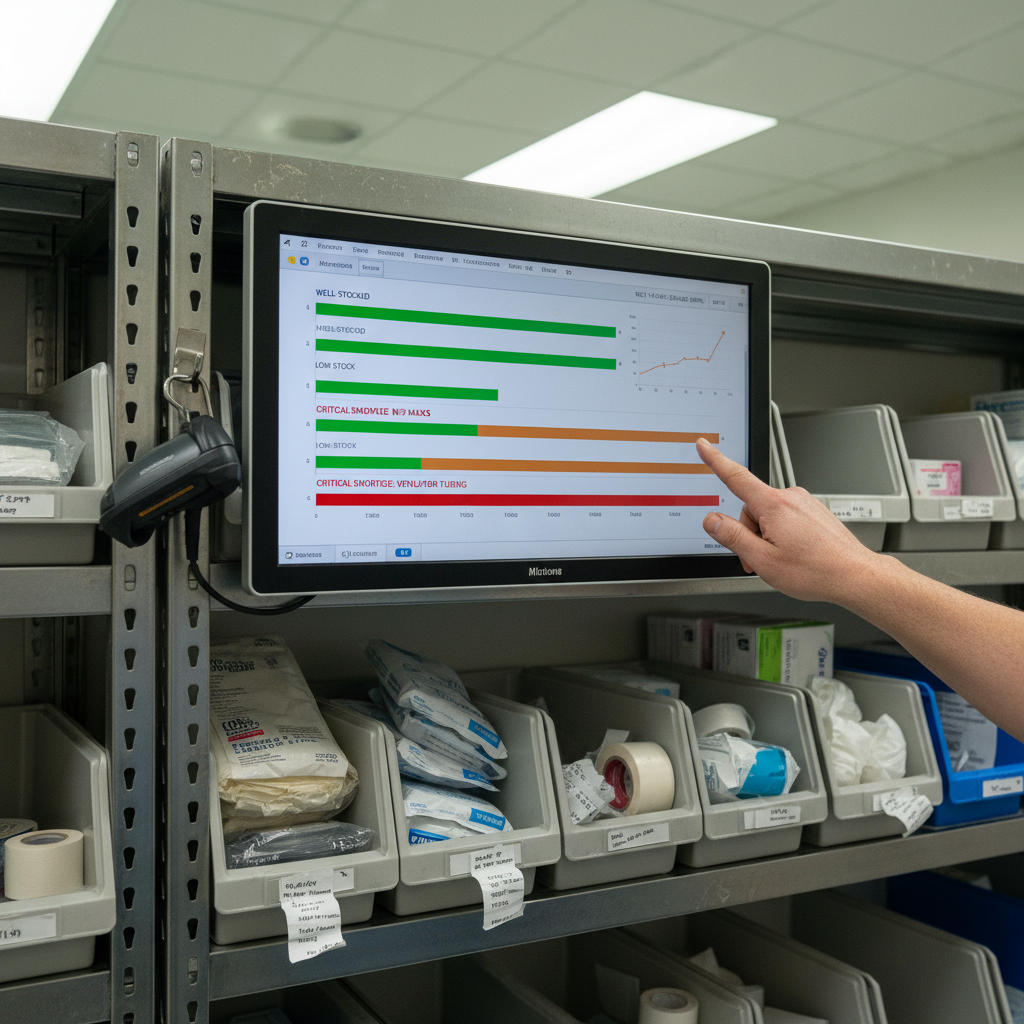
The GHX 2026 supply chain predictions name scaled, ROI-driven AI in the healthcare supply chain as the top trend of the year. Artificial intelligence is moving from pilot projects to enterprise adoption. This is not abstract.
It means three concrete capabilities are reaching operational scale:
- Predictive analytics that forecast medical supply shortage events before they hit your inventory
- Automated procurement platforms that match purchase orders to the lowest-cost compliant supplier in real time
- Demand-sensing algorithms that adjust inventory levels based on patient volume data pulled directly from electronic health records
For facilities managing dozens of product categories across multiple manufacturers, AI-powered medical procurement technology reduces the manual labor of chasing backorders, comparing prices, and monitoring contract compliance. The healthcare supply chain management market is growing at over 12% annually precisely because facilities that invested in analytics-driven procurement in 2024 and 2025 are already reporting measurable reductions in stockouts and off-contract spending.
The gap between facilities using these medical inventory management tools and those still running on spreadsheets will widen sharply in 2026.
What This Means for Your Facility: Evaluate whether your current procurement workflow provides real-time visibility into product availability and pricing. If your team is still managing vendor relationships and backorder tracking through manual processes, 2026 is the year to explore automated procurement platforms that integrate with your existing systems.
Trend 2: DSCSA Traceability Deadlines Are Live
The Drug Supply Chain Security Act is the single largest regulatory change in the medical supply chain in a decade, and its final compliance deadlines are now active. The law requires electronic, interoperable, package-level traceability for every pharmaceutical product moving through the U.S. supply chain.
Here is the compliance timeline:
- May 2025 — Manufacturers and repackagers
- August 2025 — Wholesale distributors
- November 2025 — Large dispensers
- November 2026 — Small dispensers (pharmacies with 25 or fewer staff, under an FDA DSCSA exemption)
This supply chain resiliency regulation ensures that counterfeit or compromised products can be identified and removed before reaching patients.
What does this mean for your facility? Every supplier you purchase prescription products from must provide serialized transaction data, including:
- Product name
- Lot number
- National Drug Code
- Complete chain-of-ownership history
Noncompliance carries civil fines up to $500,000 per violation and potential criminal charges. If your supplier cannot provide DSCSA-compliant documentation, your facility is exposed.
At USA MedPremium, we are LegitScript certified and fully DSCSA compliant, with electronic traceability on every prescription product we distribute.
What This Means for Your Facility: Contact every supplier you purchase prescription products from and request written confirmation of their DSCSA compliance status. If any supplier cannot provide serialized transaction data today, begin sourcing alternatives before the November 2026 small-dispenser deadline arrives.
Trend 3: Tariffs and Reshoring Redraw the Supply Map
The future of healthcare logistics is being reshaped by trade policy. Tariffs on Chinese medical devices and components reached 145% in 2025. The impact is already measurable across the industry.
The AAMC tariff impact analysis reports:
- 45% of U.S. healthcare organizations formed crisis teams to respond to the economic uncertainty
- 69% of U.S.-marketed devices are manufactured solely outside the country
- $2,000 to $8,000 in added manufacturing costs per device in the near term
Major manufacturers including Eli Lilly, Novartis, and Roche have committed over $100 billion in combined investment to reshore domestic manufacturing operations. But building that capacity takes years.
Hospitals operating on thin margins cannot absorb those increases through existing insurance contracts until 2026 at the earliest. Black Book Research found that robotics and AI adoption in U.S. healthcare manufacturing has surged 70% since 2020, and 67% of executives support reshoring as a national strategic imperative despite higher near-term costs.
For medical practices, infusion centers, and surgery centers purchasing medical supplies directly, the impact is a narrowing pool of affordable, available products. Resilient supply chain strategies now mean working with healthcare vendor management partners who source across multiple manufacturers and geographies, so that a tariff spike on one country’s products does not shut down your procurement pipeline.
What This Means for Your Facility: Audit your current supplier base for geographic concentration risk. If a majority of your critical products originate from a single country or manufacturer, diversify now. Work with suppliers who maintain relationships across multiple sourcing regions to mitigate supply chain risk in healthcare procurement.
Trend 4: Sustainability Becomes a Procurement Requirement
The World Health Organization estimates the global healthcare sector generates 300 million tons of plastic waste annually. In 2026, sustainable healthcare supply chain practices are moving from voluntary initiatives to purchasing criteria.
Health systems are increasingly requiring green healthcare procurement documentation from supplier partners:
- Recyclable packaging
- DEHP-free and PVC-free product alternatives
- Reduced shipping weight
- Consolidated deliveries that cut transportation emissions
For facilities sourcing wound care supplies, IV sets, and disposable medical devices, this trend creates both an obligation and an opportunity. DEHP-free medical supplies — which we covered in our IV therapy deep dive — are not just patient safety products. They are supply chain products that align with emerging environmental compliance requirements.
Facilities that make these transitions now avoid scrambling later when healthcare purchasing groups begin mandating sustainability metrics as contract qualifiers.
What This Means for Your Facility: Identify the top 10 disposable products your facility orders by volume and check whether DEHP-free or recyclable alternatives exist. Begin transitioning before purchasing groups add sustainability metrics to contract requirements, which multiple GPOs have signaled for 2026 and 2027.
Trend 5: Supply Chain Resilience Becomes the Enterprise Model
GHX predicts that in 2026, supply chain will become the enterprise orchestrator of risk and resilience for healthcare organizations. This is not a department function anymore. It is a strategic capability that touches clinical decision-making, financial performance, and patient outcomes simultaneously.
The organizations that perform best in 2026 will be the ones where supply chain management decisions are made at the same table as clinical and financial leadership.
For medical practices, aesthetic clinics, and infusion centers, supply chain resiliency looks different than it does for a 500-bed hospital. But the principle is the same:
- Diversified sourcing across multiple manufacturers and geographies
- Real-time visibility into product availability and lead times
- Backup supplier relationships activated before a shortage becomes a crisis
- Compliance documentation that does not require a scramble when an auditor arrives
The margin for error in healthcare logistics is narrowing every quarter. The facilities that treated procurement as an afterthought are the ones canceling patient appointments when a critical product goes backordered.
What This Means for Your Facility: Bring procurement into your leadership meetings. Even small practices benefit from a quarterly supply chain review that covers current supplier performance, upcoming contract renewals, product availability risks, and compliance status. The cost of a single canceled patient day due to a medical supply shortage exceeds the cost of proactive planning.
How We Are Building for the Supply Chain of 2026
Every trend above — from AI in the healthcare supply chain to DSCSA traceability to tariff-driven disruption — points to the same conclusion: facilities need supplier partners who are already operating in the future, not catching up to it. That is how we built USA MedPremium.
- DSCSA compliant with full electronic traceability on every prescription product
- 99.5% on-time shipment rate and 99.9% time-sensitive medication delivery across 500+ healthcare organizations
- Diversified sourcing across multiple manufacturers, so a single shortage or tariff event does not leave your facility exposed
- DEHP-free and sustainability-forward product alternatives available across our medical supplies catalog
- 15-35% bulk discounts at 100+, 250+, and 500+ unit tiers through consolidated purchasing
- 73+ facility types served, including medical practices, infusion centers, aesthetic clinics, surgery centers, home care agencies, and specialty pharmacies