Dermatology Supply Essentials: What Every Aesthetic Clinic and Dermatology Practice Needs to Stock in 2026
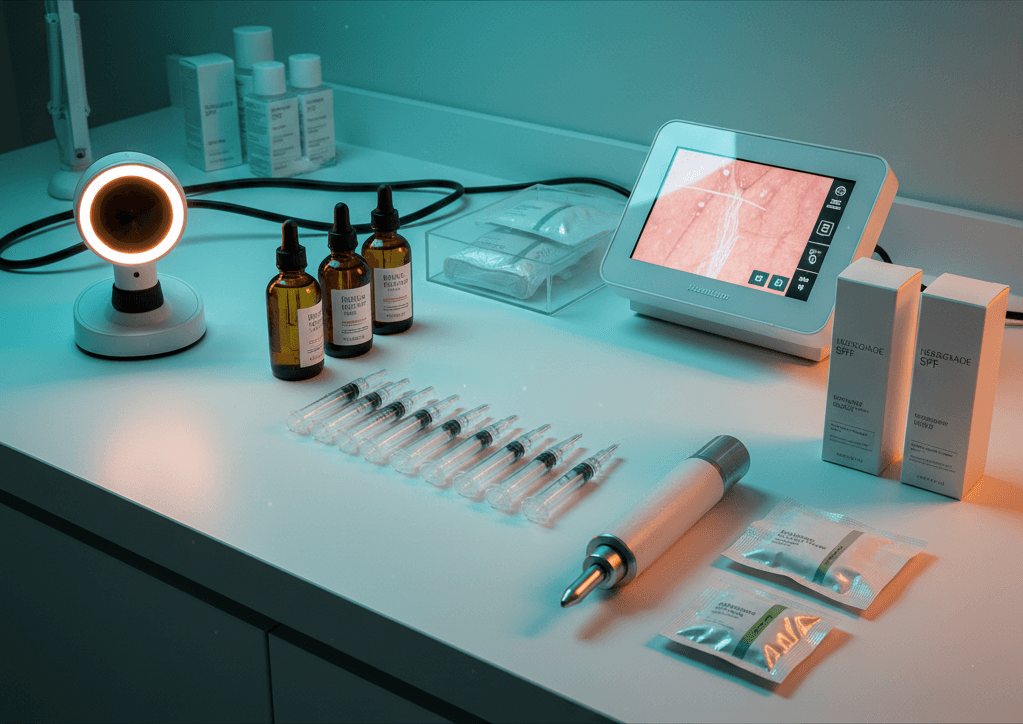
Takeaways:
- 270 active FDA-tracked drug shortages are hitting dermatology staples — lidocaine, sterile injectables, and antibiotic formulations.
- Seven supply categories make or break daily operations — including sterilization, the one most practices neglect until it shuts everything down.
- Dual-sourcing your top 10-15 products is the single most impactful thing you can do for supply resilience — your allocation during shortages is based on purchase history.
- DSCSA noncompliance fines reach $500,000 per violation — verify every supplier’s serialized traceability before onboarding.
- PE-backed platforms commanding 12-15x EBITDA vs. 4-9x for independents — centralized procurement is a key driver of that valuation gap.
When Your Supplier Says “Backordered” and Your Next Mohs Patient Is Already in the Waiting Room
Here is a scenario that has become far too common. You have a full schedule — three biopsies, two Mohs cases, an afternoon of cosmetic consults — and a procedure tray missing the one item you actually need. Your primary supplier is backordered. The backup does not carry that SKU. Staff is on the phone while your patient is in the chair.
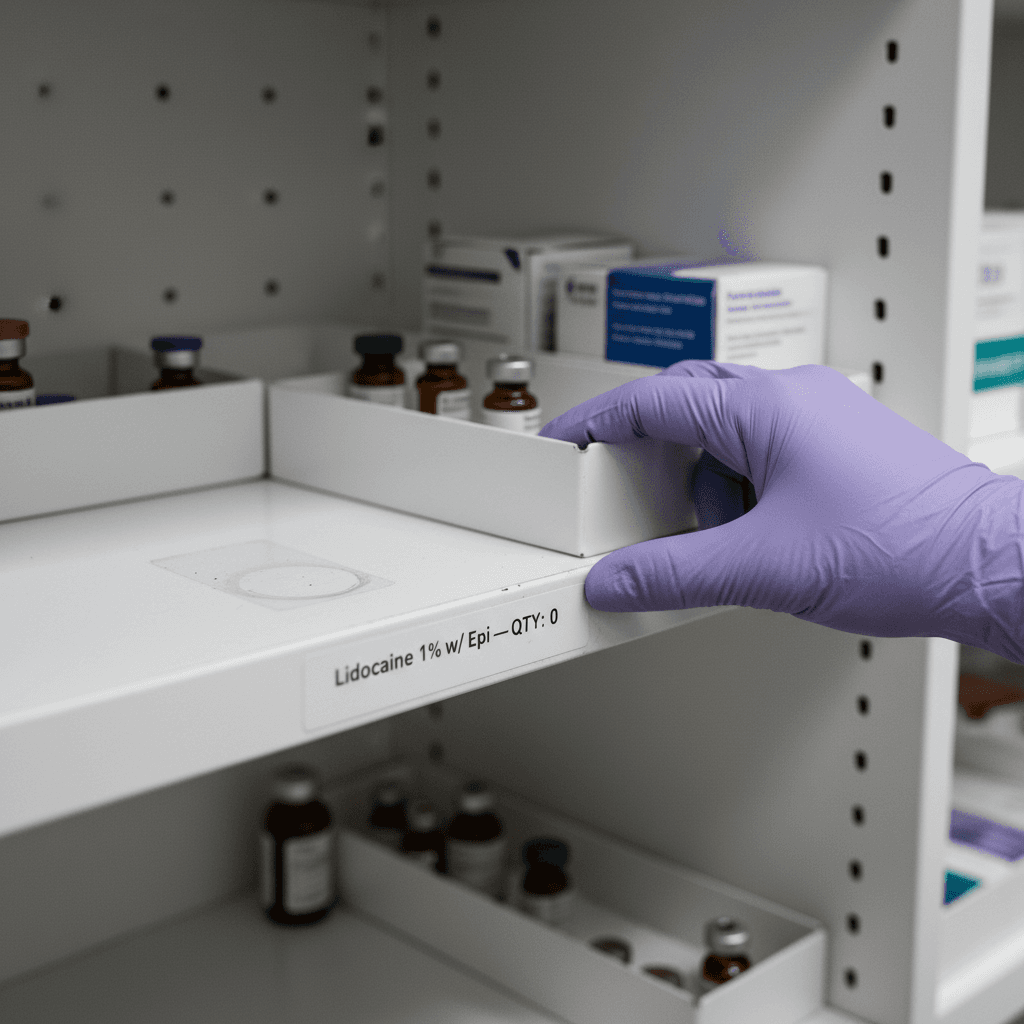
This is not a one-off inconvenience. It is a dermatology supply chain failure, and in 2026, it is happening more often than most practice owners want to admit. The FDA’s drug shortage database is tracking roughly 270 active shortages right now, and many of those hit the dermatology supplies practices depend on every day: lidocaine, sterile injectables, specific antibiotic formulations, even basic wound care dressings.
270 active drug shortages tracked by the FDA — many directly affecting dermatology practices.
- Source: FDA Drug Shortage Database, 2026
Combine that with tariffs driving up costs on imported medical devices and a 39% inflation-adjusted increase in practice operating costs, and the message is clear: procurement is no longer an administrative task you delegate and forget. It is a clinical function — one that directly determines whether your patients get treated on time or get rescheduled.
This guide breaks down what a well-stocked dermatology practice or aesthetic clinic actually needs on its shelves in 2026, and more importantly, how to source those supplies so you are never the practice scrambling when the next shortage hits.
Why 2026 Is a Different Dermatology Supplies Conversation
Five years ago, stocking a dermatology practice meant keeping a par sheet and reordering when bins looked low. That approach no longer works. Three forces are converging to make 2026 a fundamentally different procurement environment.
Skin Cancer Volume Is Climbing
The American Academy of Dermatology (AAD) reports that one in five Americans will develop skin cancer by age 70. Mohs surgeons are now performing over 870,000 procedures annually in the U.S. Every one of those procedures requires a coordinated set of Mohs surgery supplies — from scalpels and curettes to wound closure materials and sterile drapes — available simultaneously.
Aesthetic Demand Keeps Growing
On the cosmetic side, the dermal filler market alone is projected to hit $6.6 billion in 2025 and grow to $9 billion by 2035. Repeat patients account for nearly 65% of aesthetic dermatology revenue. Your ability to keep those appointments running on time — with every injectable, syringe, and post-procedure supply in stock — directly affects retention and revenue.
PE Consolidation Is Raising the Bar
Private equity consolidation is reshaping the competitive landscape. Platform practices are commanding 12-15x EBITDA multiples, while independents sit at 4-9x.
PE platform practices command 12-15x EBITDA vs. 4-9x for independents. Centralized procurement is a key driver of that gap.
- Source: Bain & Company, 2025
The groups scaling fastest are the ones centralizing aesthetic clinic supply list management across multiple locations, locking in volume contracts that smaller practices cannot match alone. If you are an independent practice or a small group, your stocking strategy is not just about convenience. It is about staying competitive.
The Seven Supply Categories Every Practice Needs to Get Right
Whether you run a medical-heavy practice focused on skin cancer or an aesthetic clinic doing injectables and laser treatments, these are the supply categories that make or break daily operations. Most guides list six. We add a seventh — sterilization and autoclave supplies — because it is the category that shuts everything down when neglected.
- Surgical Instruments & Biopsy Tools: Punch biopsies, dermablades, curettes, scalpels, Mohs trays, forceps, electrosurgery units
- Injectable Aesthetics & Biologics: Neurotoxins, HA fillers, biostimulators, microcannulas, syringes
- Prescription Topicals & Oral Meds: Tretinoin, clascoterone, isotretinoin, corticosteroids, antibiotics
- Wound Care & Post-Procedure: Adhesive dressings, Steri-Strips, non-adherent pads, wound closure strips, pressure bandages
- Sterile Supplies & PPE: Nitrile exam gloves, sterile drapes, antiseptic prep pads, sharps containers, gowns
- Diagnostic, Cryotherapy & Laser Consumables: Dermatoscopes, Wood’s lamps, cryosurgery devices, IPL filters, fractional CO2 tips
- Sterilization & Autoclave: Autoclave units, sterilization pouches, biological indicators, chemical integrators
Here is what most practices get wrong: they treat these categories as separate purchasing decisions. In reality, they are interconnected. You cannot do a Mohs case without surgical instruments, wound care supplies, sterile PPE, and sterilization capacity all functioning at the same time. You cannot run an aesthetic afternoon without injectables, syringes, lidocaine, and post-procedure dressings. One missing component shuts down the entire workflow.
Surgical Instruments & Biopsy Tools
This is the backbone of any medical dermatology practice. A well-stocked surgical supply includes:
- Punch biopsy sets (2mm through 8mm) — the workhorse of dermatologic diagnosis. A mid-size practice performing 15-20 biopsies per week should keep a minimum of 40-50 disposable punches on hand across sizes.
- Dermablades and shave biopsy instruments — for superficial lesions where a punch is unnecessary.
- Curettes (Fox and Cannon types, sizes 1-7mm) — essential for curettage and electrodesiccation of basal cell carcinomas.
- Mohs surgery tray sets — including scalpel handles (#3 and #7), Adson forceps, iris scissors, needle drivers, and skin hooks. Practices performing Mohs should maintain at least 3-4 complete sterile tray sets to handle back-to-back stages without waiting for autoclave turnaround.
- Electrosurgery units and tips — Hyfrecator-type devices with a stock of disposable electrodes in multiple configurations (sharp, blunt, ball).
Par level guidance (mid-size practice, 3-5 providers): Maintain 4-6 weeks of disposable biopsy instruments. Reusable Mohs trays should have enough sets to cover your highest-volume day plus one spare.
Injectable Aesthetics & Biologics
For any practice offering cosmetic services, this category drives the highest revenue per appointment. Key products include:
- Neurotoxins — Botox (onabotulinumtoxinA), Dysport (abobotulinumtoxinA), Xeomin (incobotulinumtoxinA), and newer entries like Daxxify (daxibotulinumtoxinA). Each has different unit equivalencies and storage requirements.
- Hyaluronic acid fillers — Juvederm and Restylane families in multiple viscosities for lips, cheeks, temples, and jawline. Stock at least 2-3 syringes per product line per provider per week.
- Biostimulators — Sculptra (poly-L-lactic acid) and Radiesse (calcium hydroxylapatite) for collagen stimulation. Sculptra requires reconstitution time — ensure staff is trained on prep protocols.
- Microcannulas — 25G and 27G in 38mm and 50mm lengths are the most common. Stock at minimum 20-30 per week for a busy aesthetic practice.
- Topical anesthetics and lidocaine — BLT (benzocaine-lidocaine-tetracaine) compounded cream and injectable lidocaine with epinephrine. Lidocaine is among the most shortage-prone products on the FDA list.
Par level guidance: Neurotoxins and fillers are high-cost, temperature-sensitive products. Maintain 2-3 weeks of stock based on rolling 4-week usage averages. Monitor cold chain compliance.
Prescription Topicals & Oral Medications
If you dispense or administer prescription medications in-office, this is where your sourcing strategy matters most.
- Tretinoin (various formulations): Retinoid
- Clascoterone (Winlevi): Topical anti-androgen
- Isotretinoin (Claravis, generics): Systemic retinoid
- Oxymetazoline (Rhofade): Vasoconstrictor
- Celacyn: Silicone-based scar gel
- Genadur: Nail lacquer kit
- Corticosteroid creams/ointments: Anti-inflammatory
- Topical antibiotics: Antimicrobial
The common thread? These are not products you can substitute on the fly. When your specific formulation is out of stock, patients notice. In an era where appointment wait times in dermatology already average 28-32 days, losing a patient to a competitor because you could not fill their prescription is not a minor inconvenience. It is lost revenue that does not come back.
Wound Care & Post-Procedure Supplies
Every biopsy, every excision, every Mohs closure needs wound care supplies. Yet this is the category most practices reorder reactively instead of proactively.
- Adhesive wound closure strips (Steri-Strips) — stock 1/4" and 1/2" widths in quantity. These are used after nearly every surgical procedure.
- Non-adherent dressings (Telfa, Adaptic) — critical for post-biopsy sites where adherent gauze would disrupt healing.
- Pressure bandages and elastic wraps — for post-excision hemostasis, particularly on extremities and scalp.
- Sterile wound closure kits — pre-packaged trays with suture, scissors, and dressings streamline Mohs closure workflows.
- Advanced wound care products — skin substitutes and collagen dressings for complex closures and chronic wounds.
For practices doing advanced wound care or post-Mohs reconstruction, the 2026 CMS reimbursement changes add complexity. Many skin substitutes have been reclassified from high-margin biologics to flat-rate “incident-to” medical supplies at roughly $127 per square centimeter. That changes the economics of which products you stock and how you source them.
Par level guidance: Maintain 4-6 weeks of adhesive strips and non-adherent dressings. These are inexpensive, shelf-stable, and catastrophic to run out of mid-procedure.
Sterile Supplies & PPE
The least glamorous category and one of the most volatile from a pricing standpoint.
- Nitrile exam gloves — stock in all sizes (S, M, L, XL). Latex alternatives are mandatory given allergy prevalence. Budget for 100-150 gloves per provider per day.
- Sterile surgical gloves — separate from exam gloves. Required for Mohs and any sterile procedure.
- Sterile drapes and fenestrated sheets — for surgical field preparation.
- Antiseptic prep pads — chlorhexidine and povidone-iodine in individual packets.
- Sharps containers — OSHA-compliant, in every procedure room. Replace when three-quarters full, not when overflowing.
- Isolation gowns — fluid-resistant for surgical and laser procedures.
145% tariffs on Chinese medical device imports are driving up PPE costs. Diversify to domestic and USMCA-compliant manufacturers.
- Source: USTR Section 301 Tariff Actions, 2025
Par level guidance: PPE is a commodity category with long shelf life. Maintain 6-8 weeks of stock and reorder on a fixed schedule rather than waiting for low-stock triggers.
Diagnostic, Cryotherapy & Laser Consumables
This category is expanding as technology drives new clinical workflows.
- Dermatoscopes — polarized and non-polarized models. Digital dermatoscopes with image capture are increasingly standard for mole mapping and AI-assisted screening.
- Wood’s lamps — for fluorescence-based diagnosis of fungal infections and pigmentary disorders.
- Cryosurgery devices and accessories — liquid nitrogen spray units, cryogen tips in multiple apertures, and insulated cone attachments for precise application.
- IPL (Intense Pulsed Light) filters and handpieces — consumable filters have a defined shot count (typically 50,000-100,000 pulses) and must be tracked and replaced on schedule. A busy aesthetic practice may go through a filter set every 2-4 months.
- Fractional CO2 laser tips — single-use or limited-use tips for resurfacing procedures. Stock 2-3 per treatment day.
- Nd:YAG and diode laser consumables — cooling gel, treatment grids, and calibration tools.
Par level guidance: Laser consumables are high-cost and procedure-specific. Track usage per device and reorder based on scheduled procedure volume, not reactive triggers.
Sterilization & Autoclave Supplies
If your practice uses any reusable instruments — and every Mohs practice does — sterilization is a non-negotiable operational requirement.
- Autoclave units — tabletop steam autoclaves (Midmark, Tuttnauer, SciCan) sized to your instrument volume. Practices running multiple Mohs stages per day need a unit that can complete a cycle in 20-30 minutes.
- Sterilization pouches — self-seal pouches in sizes matching your instrument trays. Use chemical indicator strips integrated into the pouch.
- Biological indicators (BIs) — spore tests (Geobacillus stearothermophilus) run weekly at minimum per CDC and AAMI guidelines. Many states require documentation.
- Chemical integrators — Class 5 or Class 6 integrators placed inside every load to verify sterilization parameters were met throughout the cycle.
- Autoclave cleaning solution and maintenance kits — descaling and chamber cleaning on the manufacturer’s recommended schedule prevents costly repairs.
Par level guidance: Sterilization pouches and biological indicators are inexpensive and critical. Keep 8-12 weeks on hand. Autoclave maintenance kits should be reordered with each biannual service.
How to Source Dermatology Supplies Smarter, Not Just Cheaper
It does not matter what you stock if you cannot reliably get it. Your procurement strategy matters just as much as your dermatology office supplies checklist. Here are the four sourcing strategies that separate resilient practices from reactive ones.
Dual-Source Your Critical Products
For your top 10-15 most-used products, maintain active purchasing relationships with at least two qualified suppliers. Here is why this is non-negotiable: when a manufacturer puts a product on allocation, your share is based on your purchase history with that vendor. If you have never ordered from them before, your allocation is zero — no matter how urgently you need the product.
Building a second supplier relationship now, before the shortage hits, is the single most impactful thing you can do for your practice’s supply resilience. This applies especially to:
- Lidocaine and other injectable anesthetics
- Neurotoxins and dermal fillers
- Isotretinoin and other controlled medications
- Nitrile gloves and sterile PPE
At USA MedPremium, we work with practices as either a primary or secondary source across all seven categories. Many of our clients initially onboard us as a backup supplier for shortage-prone products and expand the relationship as they see consistent availability and competitive pricing.
Track Expiration Dates with FIFO Protocols
Dermatology practices carry a mix of short-shelf-life injectables (neurotoxins, fillers) and longer-lasting disposables (gloves, dressings, sutures). A first-in, first-out (FIFO) rotation protocol prevents waste on both ends.
- Flag anything within 90 days of expiration.
- Adjust ordering patterns or reallocate near-expiry stock to higher-volume days.
- For injectables, track lot numbers and expiration dates in your inventory management system — this is also a DSCSA requirement.
Verify DSCSA Compliance for Every Supplier
The Drug Supply Chain Security Act (DSCSA) now requires electronic, package-level traceability for every prescription product in the U.S. supply chain.
DSCSA noncompliance fines reach $500,000 per violation. Verify every supplier’s compliance before onboarding.
- Source: FDA DSCSA Enforcement Guidance, 2025
Any vendor you purchase prescription dermatology supplies from — whether isotretinoin, clascoterone, or lidocaine — must provide serialized transaction data with full chain-of-custody documentation. If they cannot, they are a liability, not a partner.
- Can you provide Transaction Information, Transaction History, and Transaction Statements (T3) for every prescription product?
- Are you registered with the FDA and state boards of pharmacy as required?
- Do you use an FDA-recognized verification system for suspect and illegitimate products?
Leverage Group Purchasing for Scale
Independent practices and small groups cannot match the volume discounts that PE-backed platforms negotiate. But you can close the gap:
- Group purchasing organizations (GPOs) — join a dermatology-focused GPO to access negotiated contract pricing on high-volume consumables.
- Buying cooperatives — partner with 3-5 local practices to consolidate orders and hit volume price breaks.
- Distributor partnerships — work with a distributor like USA MedPremium that aggregates across multiple manufacturers, giving you access to broader inventory without committing to single-manufacturer contracts.
Par Level Guidelines for a Mid-Size Practice
For a practice with 3-5 providers seeing 80-120 patients per day, these par levels provide a starting framework. Adjust based on your procedure mix, seasonal volume, and lead times from your suppliers.
- Disposable biopsy instruments: 4-6 weeks
- Injectable neurotoxins & fillers: 2-3 weeks
- Prescription topicals (in-office dispensing): 3-4 weeks
- Wound care dressings & closure strips: 4-6 weeks
- Nitrile exam gloves: 6-8 weeks
- Sterile surgical gloves: 4-6 weeks
- Laser consumables (IPL filters, CO2 tips): Per scheduled volume + 20% buffer
- Sterilization pouches & indicators: 8-12 weeks
- Lidocaine (injectable): 4-6 weeks
These are guidelines, not prescriptions. Your actual par levels should be based on rolling 4-8 week usage data from your inventory management system. Practices with seasonal aesthetic volume spikes (pre-holiday, pre-wedding season) should increase injectable and laser consumable pars by 25-30% during peak months.
Stock for the Practice You Are Building, Not the One You Had Last Year
Dermatology in 2026 is not slowing down. Skin cancer volumes are climbing. Aesthetic demand is growing. And the dermatology supply chain feeding all of it is more unpredictable than it has ever been.
The practices that thrive through this will not be the ones with the biggest budgets. They will be the ones that treated procurement as a clinical function — planned, diversified, and built for the disruptions that are not a matter of if, but when.
Whether you are building your first aesthetic clinic supply list or auditing a multi-location operation, the framework is the same: know your seven categories, set par levels based on data, dual-source your critical products, and verify every supplier’s DSCSA compliance.
Ready to audit your supply shelves? USA MedPremium offers a free dermatology supply audit for practices that want to identify gaps, benchmark par levels, and build a resilient sourcing plan. You can also download our printable dermatology office supplies checklist or schedule a consultation with a supply specialist who works exclusively with dermatology and aesthetic practices.
Schedule a Free Supply Audit